Historian and Author Tom Perry's thoughts on history and anything that comes to mind.

Tuesday, March 22, 2016

Remembering Carrie Sue


                Death comes for all of us, but I really thought Caroline Susan “Carrie Sue” Bondurant Culler might live forever. She passed away this week at the age of 107 years. Born on February 7, 1909. She was born seventy-six years and one day after James Ewell Brown “Jeb” Stuart and it was General Stuart that led me to her. My “second father” Theodore Guynn was my source for Ararat history and if he did not know the answer, he answered my question with “Go ask Carrie Sue,” so I did.

                A visit to Carrie Sue along the Rabbit Ridge was an experience. I started going in my 20s when I got the idea to save J. E. B. Stuart’s birthplace because Carrie Sue had inside information. Her grandmother or great-grandmother, I cannot remember which, knew J. E. B. Stuart, and she knew her grandmother. The Pedigos and Stuarts were next door neighbors. The Pedigo and Stuart children went to school together taught by a man named Monday in one of her stories.

                She loved her Pepsi and Reese Cups. She could play a banjo and she loved to talk about local history. She especially loved to talk about true crime. Murder sells and Carrie Sue loved to talk about it. One of her favorites was the Lynch Hollow story about a man named Henry Walls, who killed a local girl named Sadie. A vigilante mob came to the home of Bob Childress’s brother, who was the constable, and relieved him of the custody of Henry Walls and put a rope around his neck and hung him on a tree in Lynch Hollow. Henry and Sadie are both buried in unmarked graves, I believe, at Hunter’s Chapel Church, where Carrie Sue’s funeral will be today, coming full circle appropriately I think.

                One story about the man named Taylor who actually put the rope around Walls neck says per Carrie Sue that he executioner had trouble with his throat in some sort of psychosomatic reaction to hanging the man.  Taylor, I think, was a relative of Sarah Taylor, the grandmother of Andy Griffith. Yes, Andy Griffith, who played Andy Taylor, who had an operator named Sarah had a relative named Sarah Taylor. I learned this from Carrie Sue.

                In today’s world where everyone is offended by everything, Carrie Sue was not “politically correct.” She had an opinion and she was not afraid to express it and if you didn’t agree with her, don’t tell her. She was refreshing in a world where everyone is some sort of homogenous non-offensive world. She was a colorful character and that is one of the things about her I enjoyed. I didn’t agree with everything she said, but I enjoyed listening to her. She was from another time period and placing today’s world view on her was not fair to her and would make the world a lot more boring.

                When she was born on February 7, 1909, Theodore Roosevelt was in his last month as President of the United States, not Franklin D. Roosevelt, but Theodore. Back then, we inaugurated Presidents in March and not January 20 as we do now. The next month, William Howard Taft became TR’s successor. Roosevelt could have run for his second term and the third he could have served since becoming President after the assassination of William McKinley.

                She did not just talk about history, she wrote history. She kept a journal and I always imagine what she wrote about me when I made these visits. “That Perry boy came to see me. I wonder if anything he writes is true?” Imagine if you will, she was ten when World War One ended. She was a mother and probably grandmother when World War Two ended.  When I was born, she was almost as old as I am today. By the time, I went to visit her, she was in her seventies. She was one of the people I wish I could have written about, but she would rather talk about others and not herself. I always tell people that if they want to know history, go talk to an older person. I am glad I did because I learned so much from Caroline Susan Bondurant Culler.


Thursday, March 3, 2016

Voting For President in Patrick County Virginia


                When was the last time a Democratic Presidential Candidate won Patrick County?

                It might surprise some to know that it was Jimmy Carter in 1976 and he just barely won the county beating President Gerald Ford 2,740 to 2, 349 out of 5,377 votes cast in the bicentennial year of our nation. I could not vote in that election, but I started voting in the next election in 1980. I am 5-4 voting for winning candidates since then and with the recent primary election I did a little research just for fun to see historically how my home county has voted in my voting lifetime and a little beyond. 

             For most of my lifetime, Virginia has been a sure thing usually for the most conservative candidate until Barrack Obama changed the scenario winning Virginia in 2008 and 2012, but not Patrick County, where got shellacked 11,113 to 5,296 in those two elections. The President should not feel bad about it though because in my lifetime only two Democrats have won The Free State of Patrick, Carter as previously mentioned and Lyndon Johnson, I believe, in 1964.

                It really surprised me when Vice-President Joe Biden showed up in the county seat to spend time at the Coffee Break during the last election because he knew his ticket had no chance of winning Patrick County. Somethings are predictable and that is often elections. For instance, it is almost impossible for a Republican candidate to win the office without winning the state of Ohio. It is just something that historically always happens.

                You can go back to study all this thanks to the internet and the Virginia Board of Elections website where you can look at past elections as a way to predict future elections. I can almost guarantee the reader that the Republican candidate no matter who he is will get around 5,500 votes and the Democrat candidate no matter who she is will get around 2,500 out of around 8,250 votes. Virginia will be decided in 2016 probably in one county in Northern Virginia and perhaps another county in the Tidewater as their populations are large and can swing either way depending on the circumstances.

             This past week the primary unusual for us in that our vote really does matter deciding the candidate for either party and you can vote in either.  Which means as a Republican you could have “Felt the Bern” and voted for the socialist Vermont Senator Bernie Sanders to sabotage Hillary Clinton. A Democrat could have voted for any of the GOP candidates to get the easiest to defeat in November. Either way you can make a difference in Virginia this year.

                I noticed that the Republican primary got 2, 517 voters, while the Democrats only had 739 voters, which is not a good sign for the latter in November in Patrick County. In Virginia, over one million voted Republican with almost 800,000 voting Democratic.

                Over the years, I have studied the voting patterns of Patrick County just for fun. Usually, the most conservative precincts are in the Dan River District close to very Republican Carroll County to the west. Usually, Patrick Springs is the most liberal precinct by who receives votes.

                Presidential Candidates who won Patrick County since I started voting are Reagan in 1980 (4297 to 2382 for Carter with John Anderson getting 105) and 1984, where he won the most lopsided Electoral College victory in history. Both George Bushes won the county in 1988, 1992, 2000, and 2004. Romney and McCain beat President Obama in 2008 and 2012. Bob Dole beat Bill Clinton in 1996 (3547 to 2301), which might surprise some.

Virginia voted for Nixon three times 1968, 1972, and 1960. “I Like Ike” was the familiar refrain in Virginia in the 1950s, but before then Virginia was part of the solid South going for Truman and Franklin Roosevelt in the 1940s and 1930s reflecting, no doubt, the influence of the Byrd Democratic Party machine.

We are Democratic Republic and we decide who is President by way of the Electoral College, which means each state gets a number of electors (13 in 2016), which I believe is based on the number in the House of Representatives, based on population and Senators (two each for the state) in the U. S. Congress.

                Now, with the 2016 election coming in November, there is a scenario where it could come down to Virginia. I went to the website www.270towin.com and it is possible that the Democrats could have 263 electoral college votes and the Republicans could have 262 votes with only the 13 votes of Virginia left to decide who is the next President of the United States. While there is little doubt that Patrick County will go for the Republican, Virginia might not. So, your vote matters in 2016 if you live in Virginia. Don’t let your future be decided by someone else voting when you can make that decision yourself. VOTE!


Here is more information about the Electoral College

http://www.archives.gov/federal-register/electoral-college/about.html

Thursday, February 25, 2016

One of J. E. B. Stuart's Tarheels: Rufus Barringer

 
Fellow Virginia Tech Hokie, Sheridan R. Barringer, recently published a new biography about his relative, Brigadier General Rufus Barringer, who rode with J. E. B. Stuart in the War Between the States. It was my great pleasure to write an introduction for the book shown below.
Rufus Barringer: An Introduction
“ If  anyone speaks to you of  subjugation, tell them is shows a total ignorance of what constitutes our armies. Long after the inhabitants crouch to the conqueror our armies will tread with the triumph of victorious freemen over the dead bodies of the vainglorious foes. North Carolina has done nobly in this army. Never allow her troops to be abused in your presence.”[1]
James Ewell Brown “Jeb” Stuart wrote these words to his wife, Flora Cooke Stuart, on February 8, 1864, two days after his thirty-first and last birthday. By this time, Stuart knew the value of his cavalrymen from North Carolina and used them as his “shock troops” in many occasions before his death on May 12, 1864.
            Stuart knew much about North Carolina being born and raised just over the state line from Mount Airy, Surry County, North Carolina, in Patrick County, Virginia. His family went to the “Old North State” to church, to shop, and pick up their mail. The Stuarts lived there the same time the famous Siamese Twins, Eng and Chang Bunker, lived in the town that later became synonymous with Mayberry on The Andy Griffith Show.
            With Stuart’s death and James B. Gordon’s on May 18, command of the 1st North Carolina Cavalry Regiment went to Rufus Barringer. He took command of the North Carolina Cavalry Brigade not quite a month later. Barringer went from Lt. Colonel to Brigadier General jumping over multiple colonels, who outranked him to take this command in what had been Stuart’s Cavalry Corps in Robert E. Lee’s Army of Northern Virginia. When Barringer took command of the brigade, the cavalry where under a joint command of Fitzhugh Lee and Wade Hampton. The latter South Carolinian soon took total command as did Barringer of the North Carolina Brigade.
            Barringer’s war ended on April 3, 1865, at Namozine Church in Amelia County, Virginia, when Philip Sheridan’s cavalry took him prisoner. As the author of this book is named Sheridan “Butch” Barringer, there is obviously a story there. Barringer went from Amelia County to breakfast with the Union Cavalry General. This show of hospitality led years later to the name of the personage who became the author of this book.
            After capture, Barringer went to City Point, Virginia, before going to Fort Delaware Prison in the river of the same name just south of Philadelphia, where he no doubt encountered men from my home of Patrick County, Virginia, in the 50th and 51st Virginia Infantry. Barringer knew Abraham Lincoln before through war his brother, Moreau, who shared a desk with the Illinois Congressman in the U. S. House. Lincoln showing the magnanimous spirit that he was known gave Barringer a letter to Secretary of War Edwin Stanton and after meeting with the Cabinet official was given his choice of prisons, which led him to Fort Delaware.
            It is easy to put the viewpoint of today’s world on people from the past. Presentism is not something I agree with as a rule, but in the case of Rufus Barringer, I see a man with vision that if all agreed with him, the United States of America would surely have made progress on the racial front faster with less conflict and cost of many lives for the next hundred years.
            In a time when many Southerners wanted to keep the newly freed African-American from having the rights that the 13th, 14th, and 15th Amendments to the United States Constitution provided, Barringer saw it differently. Just like before the war, he supported public works such as railroads, voting rights for free white men and dabbled with the reform of the judiciary. He showed a pattern for not running with the popular crowd even as war loomed when he opposed secession.
U. S. Grant wrote in his Memoirs of Robert E. Lee at Appomattox and the fight to preserve slavery “… a cause, though that cause was, I believe, one of the worst for which a people ever fought, and one for which there was the least excuse. I do not question, however, the sincerity of the great mass of those who were opposed to us…”[2]
Barringer unlike many of his Southern brethren saw the treatment of African-American differently after the end of the War Between the States that was a war between two nations, not a group of competing states. With slavery eradicated, he thought that accepting the freed slaves as citizens as the best approach for moving the now reunited United States forward.
Barringer switched parties multiple times in his life, a rare act of courage in the postwar South, to become a Republican. His former brother-in-law D. H. Hill (Thomas J. “Stonewall” Jackson was another) called Barringer and James Longstreet, who also became a Republican “lepers in their own community.”
Politics then and now makes strange bedfellows. Hill, a Presbyterian Elder refused to serve Barringer communion saying, “Republicans were not fit to sit at the Lord’s Table.” Today, such a statement might describe the opposing party. History can repeat itself in the strangest of ways.
The fact he had children with a former mulatto slave may have influenced Barringer’s thoughts, as his children would suffer under the oppression of the restored Southern hierarchy. His personal interests led him to support voting rights for the former slaves and a failed run for Lieutenant Governor in 1880 was his ultimate attempt to shape the future of his beloved North Carolina. He left politics living another fifteen years seeing the forces he opposed enforcing Jim Crow laws and keeping the entire race of people down as they had when they fought a war to preserve slavery. He did support Grover Cleveland for President in 1888 becoming a Democrat again and restoring his name somewhat in the eyes of his former compatriots.
Rufus Barringer left a legacy far different from most Confederate Generals as his mixed race sons from his liaison with the slave Roxanna Coleman made an imprint on the “Old North State.” One of his sons Warren Coleman became one of the richest African-Americans in the state owning and operating a textile mill in Concord.
Another interesting legacy of Rufus Barringer for this Virginia Tech Hokie is his son Paul Brandon Barringer, who became the sixth President of mine and the author of this book’s alma mater. This man who had D. H. Hill and Thomas J. Jackson as uncles from Barringer’s first wife Eugenia Morrison served in Blacksburg from September 1, 1907, until 1913. Bringing this story full circle, he was one of many men who served with or had a connection to J. E. B. Stuart including a brother William Alexander Stuart, who served on the Board of Visitors at Virginia Tech.
What lessons can we learn from the life of Rufus Barringer? Today, it is easy is to dismiss a man who fought in a war on the side to preserve slavery, but that misses the point. Barringer was not a stereotypical Southerner, but a man with vision. If more Southerners had followed his lead, the racial strife of the twentieth century might have been averted and this nation’s progress at least on racial issues would not have caused so much death and angst in our nation.
Therefore, this book about one of the lesser-known Brigadier Generals of the Army of Northern Virginia, a fact that would please J. E. B. Stuart like many of the men from the “Tarheel” state, Rufus Barringer fought nobly for Stuart and the South in the American Civil War.                     


[1] J. E. B. Stuart to Flora Cooke Stuart, February 8, 1864. J. E. B. Stuart Papers, Virginia Historical Society.
[2] Grant, U. S., Personal Memoirs. New York, 1885.
Below is a blog written by the Sheridan R. Barrigner about the subject of his new biography just released by Savas Beatie www.savasbeatie.com. It is available online from their website and the usual book outlets.


Rufus Barringer, a third generation American of Southern aristocracy, was born on December 2, 1821, in Cabarrus County, North Carolina. His father was Paul Barringer, an influential citizen of the county and officer in the militia during the War of 1812. His mother was Elizabeth Brandon, daughter of Matthew Brandon, a veteran of the Revolutionary War. Rufus was the tenth of eleven children, many of whom went on to achieve prominence.
 
Rufus was graduated from the University of North Carolina (UNC) in 1842, where he was active in the Dialectic Society (Debating Club), and was one of the leaders opposing the establishment of fraternities, which he considered too secretive and because he detested the severe hazing. After graduation, he returned to Concord and read law with his brother, Moreau. In June 1843, he obtained his license to practice law.

Rufus served in the North Carolina House of Delegates in 1848-49 and in the State Senate in 1850. Barringer supported progressive measures during his terms in the North Carolina Legislature, including establishment of a railroad system to serve the western part of the state,”free suffrage,” and judicial reforms.

Just prior to and during his legislative days, he purportedly had an affair with Roxanna Coleman, a mulatto slave of a neighbor in Concord. He fathered two illegitimate sons, Thomas Clay Coleman and Warren Clay Coleman. Warren Coleman is best known for establishing a black owned and operated textile mill in Concord. He became one of the wealthiest black men in the South before he died in 1904.

Also, during this period, Rufus was involved in a bitter political dispute with a prominent political figure of the time, Greene W. Caldwell. During the escalating clash with Caldwell, a duel was narrowly averted, but Caldwell attacked Barringer in the streets of Charlotte. The younger and stronger Barringer grappled with Caldwell and forced his attacker’s arm down so that three shots went through Barringer’s coat while one bullet hit him in the fleshy part of the calf of a leg. Both men were arrested and were fined, ending the dangerous affair.

After one term as a senator, Rufus tired of the legislative morass and returned to Concord, where he became heavily involved in taking care of Moreau’s practice after Moreau was elected to the U. S. House of Representatives, where, Moreau shared a desk with and became friends with another Congressman, Abraham Lincoln. This relationship proved fateful to Rufus Barringer.

In 1854 Rufus, a faithful Presbyterian, became engaged to Eugenia Morrison, fifth child of Robert Hall Morrison and Mary Graham Morrison of Lincoln County. Mr. Morrison was a prominent Presbyterian minister and the founder of Davison College. Rufus and Eugenia were married in May of 1854 and had two children, Anna Barringer and Paul Brandon Barringer. In 1874 Anna Barringer, 17, died of typhoid fever. Paul became a doctor, chairman of the faculty at the University of Virginia, and sixth President of Virginia Tech. Two other Morrison sisters married soon-to-be Confederate generals. Isabella Morrison married Daniel Harvey Hill, and Anna Morrison married Thomas J. Jackson. Thus, Rufus, Jackson, and Hill were brothers-in-law. In 1858, Eugenia died of typhoid fever. Three years later, Rufus married Rosalie A. Chunn, who died of tuberculosis in 1864, after having one child, Rufus Chunn Barringer. In 1870, he married Margaret Taylor Long, and they had one son, Osmond Long Barringer.

Barringer was a Unionist at heart and opposed secession until the failed Peace Conference of February 1861 (Moreau was a North Carolina representative to the conference). Rufus then encouraged secession and preparing the state for the war that he saw as inevitable. He raised a company of cavalry in Concord, and was elected its captain. Barringer’s Company “F” became part of the 1st North Carolina Cavalry Regiment (Ninth State Troops), commanded by Colonel Robert Ransom.

Barringer, Hill, and Jackson had cordial relations before and during the war, but Barringer and Hill became estranged over Reconstruction politics after the war. In July 1862, Jackson summoned Barringer to his headquarters to discuss Jackson’s proposed controversial “Black Flag” policy as a response to Federal commander John Pope’s threats toward Virginia civilians. Jackson never received approval for his “no quarter” war plan, and Pope’s offensive soon made the subject moot.
 
At the battle of Brandy Station on June 9, 1863, Captain Barringer, acting as major that day, was seriously wounded while placing some of his troopers in position as sharpshooters to protect the Confederate artillery of Robert F. Beckham. Barringer was shot off his horse, being hit through the right cheek by a Federal sharpshooter. The bullet exited his mouth, causing serious injury that kept him out of service for five months. He was promoted to major on August 26, 1863, and returned to service at the time of the Bristoe Campaign in mid-October. Here, he rallied his troopers at Auburn and led a mounted charge at Buckland. He was promoted to Lt. Colonel on October 17.

During the 1864 spring campaign, North Carolina Brigade commander James B. Gordon was mortally wounded on May 12 at Brook Church, five miles north of Richmond during Sheridan’s attack on Richmond to draw out and fight JEB Stuart. After the death of Gordon and the wounding of Colonel William H. Cheek on May 11, Lt. Colonel Barringer took over temporary command of the 1st North Carolina Cavalry Regiment. Three senior colonels stood ahead of Barringer to be promoted to brigadier general to command the North Carolina Brigade, but Barringer, favored by Gordon and recognized as a sound organizer and disciplinarian, was promoted over the colonels, bypassing the rank of colonel to command the brigade as a brigadier general.

General Barringer performed well during the 1864 campaigns, leading Rooney Lee’s Division due to Lee’s illness during the victorious battle of 2nd Reams’s Station on August 25, 1864. He led his brigade in other fights, including Davis’s Farm, the Wilson-Kautz Raid, and Wade Hampton’s “Beef-Steak” Raid.

At the opening of the 1865 campaign, General Barringer was conspicuous in the Battle of Dinwiddie Court House (Chamberlain’s Bed), Five Forks, and Namozine Church, where a band of Maj. Henry Young’s scouts, disguised as Confederates, captured him on April 3, 1865. He was taken to Phil Sheridan’s headquarters, where he breakfasted with the Union general. He was then sent to Petersburg and to City Point, and was at City Point on April 5, when President Lincoln visited. Barringer was the first Confederate general officer captured and brought to City Point, and Lincoln, hearing the name Barringer of North Carolina, asked that Barringer be brought to see him. Lincoln thought that the prisoner might be his old friend Moreau Barringer. The two men had a congenial conversation for a period of time. Lincoln gave Barringer a note of introduction to Secretary of War Edwin Stanton, since Barringer was being sent to the Old Capitol Prison in Washington. Barringer then met with Stanton for short periods over several days. Stanton had to clear out the prison because many prisoners were being received and gave Barringer the choice of prisons to be sent to. The hapless Barringer chose Fort Delaware—the worst choice he could have made.

Barringer arrived at Fort Delaware and stayed there until July 25, 1865, even though he made numerous attempts to obtain a release. After his release, he went to Washington in an unsuccessful attempt to obtain his pardon, and then went home to Concord, North Carolina. Moving to Charlotte during the post war period, he became a “Radical” Republican and strongly supported Reconstruction and was condemned by the Democratic press as a “traitor to his state.” D. H. Hill termed Barringer, and other Republicans, especially James Longstreet, as “lepers in their own community.” Hill, an elder of the First Presbyterian Church of Charlotte, refused to serve Barringer the sacraments at communion, declaring that “Republicans were not fit to sit at the Lord’s Table.” Barringer, angered at such treatment, transferred his membership to the Second Presbyterian Church and became an elder. A fearless politician, Barringer boldly stood his ground and supported black suffrage and other progressive measures to better the lives of the common people.

In 1880, Rufus Barringer was the Republican candidate for Lt. Governor, and was defeated along with Republican gubernatorial candidate Ralph Buxton, even though they nearly carried Barringer’s Democratic district. During the 1888 national election, Barringer switched parties, supporting Democrat Grover Cleveland for president. Suddenly, he was a hero to the Democratic Press, and remained so for the rest of his life. He died of stomach cancer on February 3, 1895 and was buried in Elmwood Cemetery in Charlotte.


Wednesday, February 17, 2016

Mercy Street and Martinsville Virginia


           PBS is airing a new Civil War era show on Sunday night called Mercy Street about a Union hospital in Alexandria, Virginia. What you might not know is there is a connection locally to J. E. B. Stuart and Martinsville in one character in the show and one real life cavalryman, spy, and man of God.      
Born on June 18, 1840, at The Retreat along with Rapidan River in Culpepper County near Raccoon Ford, Benjamin Franklin Stringfellow began the year 1861 in Noxubee County, Mississippi, far away from the state of his birth and the battlefields that his fame as a Confederate Scout would grow. He was a teacher of Latin and Greek. His own education began south of his home in Albemarle County before enrolling in Episcopal High School in Alexandria and graduating in 1860. This gave him knowledge of Alexandria and led him to an assignment that in 2016 would put him on PBS in Mercy Street.
            In the summer of 1861 Benjamin Franklin Stringfellow came face to face with James Ewell Brown “Jeb” Stuart during the First Battle of Manassas. Stuart’s keen eye for the talent of war drew him to young Stringfellow. Frank asked Stuart directly if he could serve under him and Stuart knowing of the younger man’s prowess as a scout invited him to serve as “his personal scout.” Stuart said of Stringfellow, “A young man of extraordinary merit.”
After the Battle of First Manassas in July 1861, Stringfellow served under Stuart.  Serving as scouts in this same command, among others, were other men who became well known such as Redmond Burke, Will Farley, and John S. Mosby. The two former became mentors for Stringfellow.
            Author Allen Foster described scouting or spying as "the most dangerous and thankless form of Civil War military service," in The Eyes and Ears of the Civil War and hardly the business of a weakling. Yet to see Frank Stringfellow clean shaven, blonde, blue eyed, 94 pound, teaching classic languages in Mississippi in 1860, one could hardly imagine that he became as Author John Bakeless in Spies of the Confederacy called him “the most dangerous spy in the Confederate army.”
            A scout or a spy “ran the gauntlet” “often going alone on secrets missions” such was the life of Frank Stringfellow. Stringfellow’s first mission was in Alexandria behind the Union lines. He had another agenda as his fiancé Emma Green lived there too. He scouted when with the army, but when he went out alone, he was a spy, dressed in civilian clothing, a hanging offense if captured out of uniform.
            Bakeless describes one of Stringfellow’s early assignments, January through April 1862, had him posing as a dental assistant and living in the home of the dentist. A cover story was devised in the including an assumed identity, fake baptismal and medical certificates. The agent had to know about the man he was impersonating, a real dental assistant who was with the army and hundreds of miles away. His job was to read all the daily newspapers. Why? They were full of military intelligence. The press considered it a sacred duty to keep the public informed, in spite of outcries by the generals. The more things change, the more they stay the same. They say history never repeats itself. After reading the papers, Stringfellow wrote out a report and left it in a certain place outside the dentist’s office. Each night another agent picked it up and, presumably, delivered it to the Confederate government in Richmond.
            One day a man with his face wrapped in a towel disappeared into the dentist’s office with Stringfellow and horrified those in the waiting room with howls of excruciating pain. He left still holding the towel to his face. The man was a fellow agent with so urgent a message it couldn’t wait to go through the usual nocturnal channels of communication. One of the people in the waiting room was a federal officer who apparently never guessed he had just witnessed a classic scene of espionage.
            Trouble arose when the dentist’s wife began to show more than friendly interest in Stringfellow, who personally had the highest of moral codes. The dentist, already aware of his assistant’s true identity, noticed his wife’s seeming infatuation and promptly reported the agent to Union authorities. For the first time, but certainly not his last, Stringfellow fled for his life.
            He returned to Stuart in time for the First Ride Around McClellan in June 1862 around Richmond. Stuart wrote in Official Report of the Seven Days, “My escort did good service. Private Frank Stringfellow, Fourth Virginia Cavalry, was particularly conspicuous for gallantry and efficiency at Cold Harbor. The majority of the Hanover Company (G), Fourth Virginia Cavalry, possessing invaluable merits as guides, were distributed as such among the various generals.” Later than summer, he led Stuart on his raid on Catlett’s Station nearly capturing Union General John Pope.
            As 1862 became 1863, he was back in Alexandria. This bring us to one of the more famous and humorous incidents of Frank Stringfellow. “One evening just before dark, the Scout was walking along the street in enemy occupied Alexandria. He turned a corner and suddenly came face to face with a Federal officer, who having seen him before, recognized him as a Confederate. Realizing that capture could have a very disagreeable ending, the scout turned and fled at top speed, as there were many other Federal soldiers along the street. Calling to him to ‘Halt,’ and calling to the soldiers along the route, the officer soon had a large detail on his trail. Joined by fresh men, the pursuers gained on the scout, who dodged around corners and ran on until he felt he could go no further.
            Suddenly he saw the open door of a house just ahead. He dashed in and slammed the door behind him. Seeing no place downstairs to hide, he quickly mounted the stairs. In the first room was an old lady, wearing the hoopskirt of the time, and sitting at a table darning a tablecloth. Taking in the situation, as she recognized him, she quietly said, ‘Here Frank.’
            Lifting her skirt, she indicated his hiding place. He quickly took his place, and she adjusted the folds of her dress, and draped the tablecloth over the table and the hidden scout. Calmly she resumed her darning.
            As the soldiers dashed into the house, they quickly searched the downstairs rooms with no success. Mounting to the next floor, the officer addressed the quiet old lady. ‘Where is he? He came in here’ the old lady continuing her darning, answered, “Who are you looking for? Someone ran in the front door a moment ago. He must have run through, and out the back door.’
            Taken aback, the Federals continued to search the upper rooms a while longer; then left the house. “Once he emerged from his hiding place resolved from that day on to be a better and more Christian man. That I shall speak of myself is because much of my experience was acquired when I was alone with God.”


          With the end of the war Frank Stringfellow found himself with $10,000 on his head and the title of “the most dangerous man in the Confederacy.”  He tried to make a go of it as a farmer in Culpeper. He wrote, “I wish you could see my hands now. I can boast of seven blisters on one hand and lots of corns. Tomorrow morning, I expect to begin my crop. There is but little money in farming at present, but green backs are not the only desirable thing in life, I wish good habits.” 
            In 1867, he returned to Virginia to farm at “Wakefield” in Fairfax County. He married Emma Frances Green that year. They had six children. After months of study, Stringfellow entered the Episcopal Seminary of Virginia, and became an ordained minister in 1876 at age 36. In the years that followed, he held charges in Powhatan, Middlesex, Farmville, Boydton, and other counties of Virginia.
            He didn’t stay long in one place. He told friends when they urged him to settle down, ‘I don’t think it’s good for a minister to hold a church too long. His congregation gets used to him, and they’re likely to stop listening to what he says.”  Rev. Stringfellow was what we would today call a “rainmaker.” He built churches everywhere he served in the impoverished South, and employed his well-honed ingenuity and humor to solve any problem.
 
          From 1890 until 1894 Franklin Stringfellow served as Rector of Christ Episcopal Church in Martinsville, Virginia. Virginia Windle recorded in the Christ Church Chronicles Spring 1990 that on September 1, 1890, Reverend Frank Stringfellow was rector of Patrick Parish in Henry County with 54 communicants.
            Stringfellow was already in Martinsville at least several months before September 1890. During his tenure in Henry County Stringfellow was involved with Confederate Veterans groups. In fact, when the Stuart-Hairston Camp of Confederate Veterans chartered on May 26, 1890, the Chaplain was Frank Stringfellow with Commander Peter Hairston, Adjutant James S. Redd, oand ther commanders included W. W. Morris, James G. Penn, and B. F. Powell. Quartermaster was C. B. Bryant, Treasurer was S. G. Sheffield, Surgeon G. E. Waller, and Assistant Surgeon P. R. Drewry. Members included Thomas J. Jamerson, J. R. Armstrong, J. M. Smith, H. J. Winn, G. T. Franklin, J. O. Coon, W. T. Redd, Alexander Joyce, and J. H. Brown.
            On March 14, 1892, Bishop Randolph confirmed more than 150 people. The next month there was 72 communicants. That same month, Franklin County reunited with the Patrick and Henry Counties. Stringfellow confirmed six people in Rocky Mount preaching the first sermon by an Episcopal minister in that place.
            A month later construction on a Rectory began and completed on April 2, 1892, at a cost of $3,000. “This project was accomplished in large measure due to the untiring effort of Mr. Stringfellow.”
            Stringfellow tried to expand the influence of his church into neighboring counties such as Patrick. He spoke on August 25, 1892, at Patrick Springs. Earlier that year he was in Franklin County speaking at Rocky Mount on March 15, 1892. All this comes from the records of Christ Church in Martinsville.
            In 1892, Stringfellow became a director of the Fife Tabernacle Association that led by Reverend W. P. Fife led a “great evangelistic campaign.” A group including President Henry Clay Lester as President, C. B. Bryant as Secretary, Treasurer J. W. Carter and directors James M. Smith and O. C. Smith raised capital stock of $3,000 to $10,000. They built a building at the end of Ellsworth Street across from Water Street at the back of Pannill Knitting
            On May 23, 1893, the congregation decided to “erect a comfortable brick church to hold a congregation of 275 at a cost of $5,000.” On December 1, 1893, Frank Stringfellow continued his pattern and resigned as the Rectorship of Patrick Parish and moved to Nelson County. The Reverend Alfred W. Anson succeeded Stringfellow.
            Stringfellow wrote of his time in Martinsville, “From the growth of the town and a new charter with important amendments and from other causes, we fell that this Parish is in better condition than it was ever known before, for all of which may God almighty receive all the praise.”
            Frank Stringfellow went home to the Lord on June 8, 1913. He rests today in Ivy Hill Cemetery in Alexandria beside his wife Emma.
 
Sources:
Peavey, James D. Confederate Scout Virginia: Frank Stringfellow
Jones, Virgil Carrington. Ranger Mosby
Williamson, James A. Mosby’s Rangers
Records of Christ Episcopal Church
Smith, A. Franklin, Information in the Christ Church Episcopal Records


Monday, February 8, 2016

Patrick County's World War Two Bull Mountain Plane Crash


Watching Deb Coalson Bisel's story last week about the young man from Kansas, Neale Narramore, who died in a plane crash in March 1944 during World War Two on Bull Mountain reminded me of this history about Patrick County.


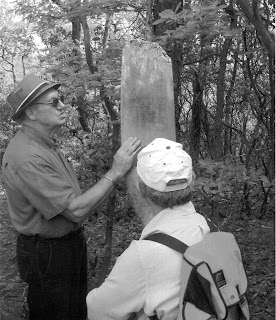
Clarence Hall, shown above at the marker on Bull Mountain with the men who died names inscribed on it, taught at Patrick County High School and was the father of  my classmate Tammy Hall has spent decades researching this crash.


The site of the crash shown above in 1944 is owned by local vet Lock Boyce, who will allow you to visit the site if you contact him. http://boyce-holland.info/

Deb Coalson as we know her is an accomplished author and historian, who grew up on Willis Gap in Patrick County. She is my friend and I am proud of how she still uses her love of history to bring it home in far away Kansas. Here is her story
http://www.aroundkansas.com/portfolio-view/neale-narramore/

Here is some information from my website about this based on Clarence Hall's research www.freestateofpatrick.com/wwtwo.

 
There is a display about the crash in the Patrick County Historical Society Museum in Stuart, Virginia. Clarence Hall, shown below with some of the research he collected, contacted many of the family members and worked with other veterans to get a marker at the crash site and in front of the Patrick County Courthouse shown below.

 
The monument on the Patrick County Courthouse in Stuart, Virginia.


Monday, February 1, 2016

Andy Griffith's Claudville (Red Bank) Virginia Connection


Above, Andrew Jackson Nunn sits in the foreground with his crutch visible in front of his store in Claudville, Virginia, after the Civil War. Below, Carl, Andy and Geneva Nunn Griffith in a 1957 parade in Mount Airy, North Carolina. Geneva was the niece of Andrew J. Nunn.


Following “Stonewall” Jackson was tough on many men. The only way to avoid service was death, sickness, or a wound. Andrew J. Nunn of Westfield, Stokes County, North Carolina found himself as part of the latter as his compatriots in the 21st North Carolina Infantry Regiment moved down to the Peninsula between the James and York Rivers to fight with Robert E. Lee’s Army of Northern Virginia.

Nunn found himself left behind at Mount Jackson, Virginia, in the Shenandoah Valley at the beginning of June 1862. Although Mount Jackson not named for Thomas J. Jackson, who received his famous sobriquet “Stonewall” at the Battle of First Manassas as the Southerners called it, the valley became famous for the exploits of the former VMI Professor. The Yankees called it First Bull Run when South Carolinian General Bee told his to “look at Jackson standing like a stonewall.”
                Nunn probably received a wound at the First Battle of Winchester on May 25, 1861. The regiment lost 21 killed and 60 wounded. Serving under Richard Ewell’s Division in the brigade of Isaac Trimble, Nunn saw some hot action. One blogger described it this way. “Dawn of May 25th found Banks’ forces defensively positioned on a range of protective hills just south of the town. Jackson launched assaults on both Federal flanks and immediately encountered fierce resistance. On the Confederate right, near the Front Royal road, Trimble ordered his “two Twenty Firsts” to charge a strongly positioned Union regiment. A member of the 21st North Carolina described the ensuing charge: “With a wild cheer the regiment moved swiftly towards the enemy’s line behind stone walls, and was met by a most terrific fire of infantry and grape shot. The regiment moved right on to the stone wall, from which the enemy were pouring forth a perfect storm of canister and minie balls from right and left–cross-firing upon us.” Despite initially wavering in the intense fire, the Carolinians regrouped and joined their brothers in the 21st Georgia in driving the Federals from the field.”

Later, Nunn possibly was one of 13 wounded at Cross Keys and Port Republic culminating Jackson’s Valley Campaign, one of the most famous military maneuvers in history. Andy Nunn recovered from his wound to fight on.  
             He was one of the “Mountain Boys” that enlisted on May 29, 1861, in Danbury, Stokes County, North Carolina. The men traveled to nearby Danville, Virginia, where they became Company F of the 21st North Carolina Infantry Regiment (11th North Carolina Volunteers). The regiment included men from Davidson, Surry, Forsyth, Stokes, Rockingham, and Guilford counties.

Nunn enlisted as a Private at age 26. Other than reported sick in October 1861, his early time in the war was not memorable. Eleven months later, his compatriots elected him 3rd Lieutenant on April 26, 1862. By June 1, he was in the hospital at Mount Jackson. He returned to duty and received promotion to 2nd Lieutenant on August 28.
             The area around Winchester was not lucky for Nunn. Two years later as part of the 2nd Corps of the Army of Northern Virginia under General Jubal Early in Lewis’s Brigade on July 20, 1864, he received wound in the left thigh that broke his femur. His luck ran out at Stephenson’s Depot, when Union forces captured him. He spent the rest of the war in either Federal Hospitals or Prisoner of War Camps.

On May 9, 1865, Nunn was at Fort McHenry, Maryland, where Frances Scott Key received his inspiration to write the Star Spangled Banner five decades earlier. Union General Lewis Wallace, who later wrote Ben Hur, signed the order transferring Nunn from the General Hospital in Baltimore. On June 24, Nunn took the Oath of Allegiance and was released ending Andy Nunn’s Civil War.
Nunn moved to Patrick County, Virginia, after the war marrying Louisa Anderson and settling in the Red Bank (Claudville) area. He ran the first store in the area, built by William C. Bateman. The Patrick County Heritage Book Volume II on page 128 describes Andrew J. Nunn as “an astute business man, who shipped dried apples, chestnuts, turkeys, chickens, and hams by wagons and oxen as far as Winston-Salem, North Carolina, Danville, and Norfolk, Virginia.” The store may have served as a voting precinct and post office.
                Years later, the daughter of Andrew’s younger brother Samuel Nunn would name her only son after the two Nunn brothers. Geneva Nunn called him Andy Samuel Griffith. He went on to be the most famous person to come from Mount Airy, Surry County, North Carolina.
Few references to the Civil War mentioned on The Andy Griffith Show except one memorable one in Episode “The Loaded Goat” from 1963 when Sheriff Andy Taylor tells a lady, who called the Sherriff’s office that the blasting she is hearing out on the highway is not the Yankees attacking Mayberry and he assures her that the South is still holding on to Richmond, Virginia, the Capital of the Confederates States of America.
This is partially an excerpt from Beyond Mayberry: A Memoir of Andy Griffith and Mount Airy North Carolina by Thomas D. Perry available online at www.freestateofpatrick.com and new material provided by Jim Collins.
 
What may be Andrew Nunn's store today in Claudville today shown below from 02/01/2016


Andrew J. Nunn's grave behind the store